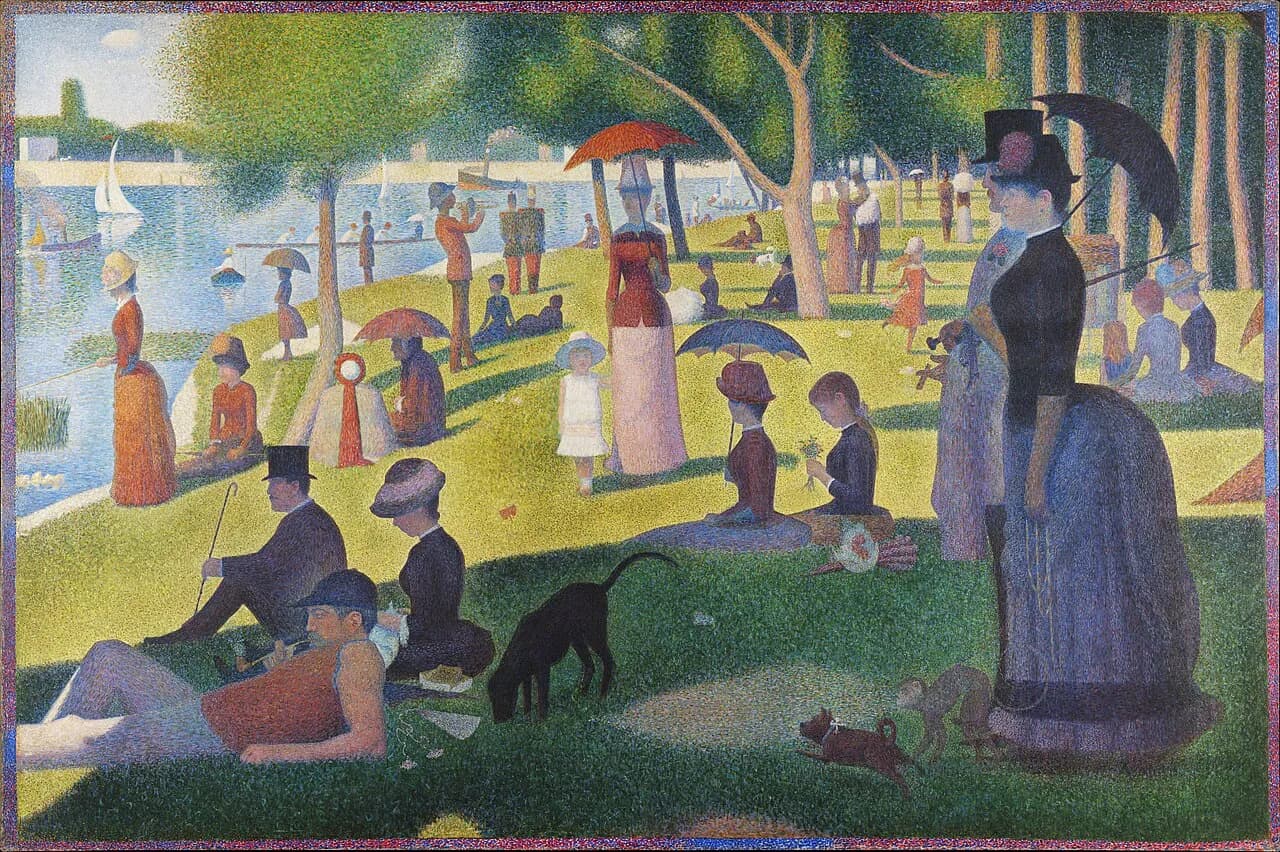
la grande jatte (1884-1886) by georges seurat
in a society where time is money, what about rest?
what about play?
lately, i've had more free time while transitioning between jobs. i've been diving into hobbies i love, yet i can't fully enjoy them. i keep setting monetary and quantitative goals for everything i do, nagged by the feeling that i should be doing more, or i'll fall behind.
reflecting on this tension, i realized that i never do anything just because anymore. every item on my to-do list serves an external purpose, tethered to some goal.
when i was younger, i'd lose myself in simple tasks: weaving a bracelet, playing with clay, completely absorbed in the moment. what changed? the answer, I found, wasn't just personal. it was structural.
the illusion of the rat race
hustle culture glamorizes grinding, "locking in", and suffering toward your goals. we constantly feel like everyone is doing more than us, and we fuel this comparison through social media, curating images of our most optimized selves.
in a capitalist society, productivity shapes our identities, gives our lives structure, and guides us toward purpose. at the same time, many of us are carrying internalized pressure to constantly do more, be more, and have more. work bleeds into personal life until every moment becomes an opportunity to get ahead. even personal choices become strategic moves. the result is emotional, cognitive, and physical burnout, which are at all-time highs across professions.
what makes this harder to stomach is that the rewards aren't keeping up. according to the economic policy institute, productivity and inflation-adjusted pay grew together from WWII through the 1970s. but since 1979, productivity has far outpaced wages. despite being underpaid and burnt out, we're still drawn into the race.
this structure has deep roots. the industrial revolution brought clocks into the workplace, making time a tool of discipline and tying productivity directly to worth. for many, there's also a cultural layer: if you were raised believing that opportunities are fragile and progress is easy to lose, rest feels more dangerous than restorative.
we've been conditioned to equate self-worth with output. busyness has become a status symbol. in our twenties especially, there's a pervasive belief that any slowdown means falling behind. the system has pulled us into a state of constant stress where rest feels like a threat.
what is proper rest?
rest allows us to pause, reflect, and reconnect with the world around us. when it's neglected, we can't process our experiences or meet our emotional needs.
guilty rest is not rest. when your mind is still spinning through your to do list, you're still in a stress state. for me, constantly telling myself I was "fine" while exhausted only reinforced the stress cycle.
how can we learn to rest?
i think the most important shift is unlearning the idea that rest is something you earn. when rest depends on finishing your to do list, it will never come, because the list never ends.
what's helped me is reframing rest as an investment in my future self, as natural and non-negotiable maintenance. I've started treating it like any other commitment with a set date and time.
i've learned to make peace with the idea that sustainable growth sometimes looks like doing less. overworking myself into misery was never the point.
the importance of play as an adult
for many of us, rest has become passive by default: collapsing on the couch, scrolling, zoning out. these moments of decompression have their place, but some of the most restorative rest is actually active. that's where play comes in: a dimension of rest we've largely abandoned as adults.
play looks different for everyone, but at its core it's mentally absorbing. it draws you into flow, engages you in the present moment, and fulfills you without demanding productivity. it reconnects you with a part of yourself lost in the pursuit of optimization. studies show that play through art and creativity correlates with lower perceived stress, improved emotional intelligence, and greater resilience. it gives us cognitive resources and adaptive coping strategies to draw on when things get hard.
play is not meant to serve an external purpose, be monetized, or earn validation. it exists for its own sake. a playful society contradicts a capitalist one, because play is about intrinsic motivation and joyful engagement, not metrics or approval.
to reclaim rest and play is to reclaim a part of yourself you were never meant to lose, and reject a system that doesn't serve you.